 EN
EN English
 русский
 Español
 عربى
عربى
 Online Message

For most hotels, a 60% cotton / 40% polyester percale blend at 200–300 thread count is the optimal hotel bedding fabric choice. It balances the softness guests expect with the durability commercial laundry demands, surviving 250–350 industrial wash cycles while costing 30–45% less per unit than pure long-staple cotton. Luxury properties serving guests at rates above $300 per night should move to 100% long-staple cotton sateen at 300–500 thread count, where tactile quality measurably influences review scores and repeat bookings.
This guide covers every fabric variable that matters in hotel operations — fiber type, weave structure, thread count, laundering durability, and true cost per wash cycle — so procurement managers and hoteliers can make a data-backed decision rather than relying on supplier claims.
Content
- 1 Why Hotel Bedding Fabric Demands a Higher Standard Than Residential Linen
- 2 The Five Main Hotel Bedding Fabric Types: Strengths and Trade-Offs
- 3 Thread Count and Weave Type: What the Specifications Actually Mean
- 4 Matching Fabric Specification to Hotel Tier and Guest Profile
- 5 Total Cost of Ownership: Calculating True Fabric Value Per Wash Cycle
- 6 Laundering Compatibility: Matching Fabric to Your Laundry Operation
- 7 Climate and Property Type: How Environment Should Influence Your Fabric Choice
- 8 Frequently Asked Questions About Hotel Bedding Fabric
- 8.1 Q1: What thread count do most 5-star hotels actually use?
- 8.2 Q2: How often should hotel sheets be fully replaced?
- 8.3 Q3: Is white the only practical color choice for hotel bedding fabric?
- 8.4 Q4: What is the best hypoallergenic hotel bedding fabric for sensitive guests?
- 8.5 Q5: Can hotels use different bedding fabric specifications for different room categories?
- 8.6 Q6: How many sets of sheets per bed should a hotel carry in inventory?
Why Hotel Bedding Fabric Demands a Higher Standard Than Residential Linen
A residential sheet is laundered roughly 50–80 times over its entire lifespan. A hotel sheet at 75% average occupancy endures 200–300 industrial wash cycles per year — at 60–71°C (140–160°F) for hygiene compliance, with commercial-strength detergents, and through high-capacity tumble dryers that generate far greater mechanical stress than home appliances.
At the same time, hospitality research consistently identifies bed comfort as the top factor in guest satisfaction, ranking above room cleanliness, bathroom quality, and in-room amenities. Fabric sits at the intersection of operational efficiency and the guest experience score that drives online reputation and direct bookings.
Any fabric specification selected for a hotel must simultaneously satisfy five operational criteria:
- Wash cycle durability: Minimum 150 cycles before visible degradation; 200+ for acceptable return on investment.
- Thermal comfort: Adequate breathability across a range of guest body temperatures and room climates.
- Visual appearance: Maintains bright white or consistent color after repeated bleach-based wash cycles.
- Laundry efficiency: Low-wrinkle recovery reduces ironing time and labor cost.
- Allergen resistance: Tightly woven or hypoallergenic fabrics reduce guest complaints from dust mite sensitivity.
The Five Main Hotel Bedding Fabric Types: Strengths and Trade-Offs
Cotton-Polyester Blend — The Commercial Hotel Standard
The 60/40 or 50/50 cotton-polyester blend is the workhorse of the hotel linen industry. Polyester adds tensile strength, wrinkle resistance, and colorfastness that pure cotton cannot sustain under industrial laundering. Cotton contributes breathability, softness, and the natural hand feel guests associate with quality. At a typical cost of $8–$18 per flat sheet (queen size) and a usable lifespan of 250–350 wash cycles, the cost per wash is the lowest of any fabric category — roughly $0.04–$0.07 per use.
100% Cotton — Long-Staple and Standard Grades
Pure cotton sheets — particularly long-staple varieties with fiber lengths above 38 mm — deliver superior softness, breathability, and a premium hand feel that is standard in 4- and 5-star hotels. The trade-offs are real: 100% cotton wrinkles significantly more, demands more ironing time, and typically withstands only 150–200 industrial wash cycles before fiber thinning becomes visible — 20–30% fewer cycles than a quality cotton-poly blend. Unit cost runs $20–$55 per sheet for long-staple grades.
Microfiber Polyester — Economy and Budget Properties
Microfiber sheets — ultra-fine polyester filaments woven at high density — are the lowest-cost option at $5–$12 per sheet and are highly wrinkle-resistant. They suit economy hotels and high-turnover budget properties where laundering speed and low replacement cost dominate purchasing decisions. Their critical weakness is poor breathability: microfiber traps heat and moisture, making it unsuitable for warm climates or properties without reliable air conditioning.
Bamboo-Derived Fabric — Boutique and Eco-Focused Hotels
Bamboo viscose and lyocell offer exceptional softness, natural moisture-wicking, and a sustainability story that appeals to eco-conscious travelers. The practical limitation is durability: bamboo viscose degrades under alkaline commercial detergents and high-temperature washing, typically lasting only 80–120 wash cycles before surface wear appears. Most viable for boutique eco-hotels with gentle on-site laundry programs.
Linen (Flax) — Specialty, Resort, and Design Hotels
Linen is the most breathable natural fiber available for hotel bedding and softens with each wash rather than degrading — enabling a lifespan of 300–500+ wash cycles, the longest of any natural fabric. Its drawbacks are high acquisition cost ($40–$90 per sheet), a textured hand feel not all guests appreciate, and a naturally wrinkled appearance that conflicts with the crisp-white aesthetic most hotel brands require.
Thread Count and Weave Type: What the Specifications Actually Mean
Thread count — the number of horizontal and vertical threads per square inch — is the most heavily marketed specification in hotel bedding and one of the most misunderstood. Two principles matter more for procurement decisions:
- The practical thread count range for hotel cotton sheets is 200–400. Below 200 feels coarse and wears quickly. Above 400, manufacturers typically inflate counts using multi-ply twisted threads — a practice that adds weight and reduces breathability without improving tactile quality.
- Weave structure determines texture and durability more than thread count does. Two sheets with identical thread counts in different weaves will feel and perform entirely differently.
| Weave Type | Hand Feel | Breathability | Wrinkle Resistance | Best Application |
|---|---|---|---|---|
| Percale (plain weave) | Crisp, cool, matte | Excellent | Low | 3–4 star, warm climates |
| Sateen (4-over-1 weave) | Silky, smooth, lustrous | Moderate | High | 4–5 star, luxury, boutique |
| Twill | Diagonal texture, firm | Good | Moderate | Resort, spa, adventure hotels |
| Jersey Knit | Stretchy, T-shirt soft | Good | Very high | Lifestyle, capsule, youth hotels |
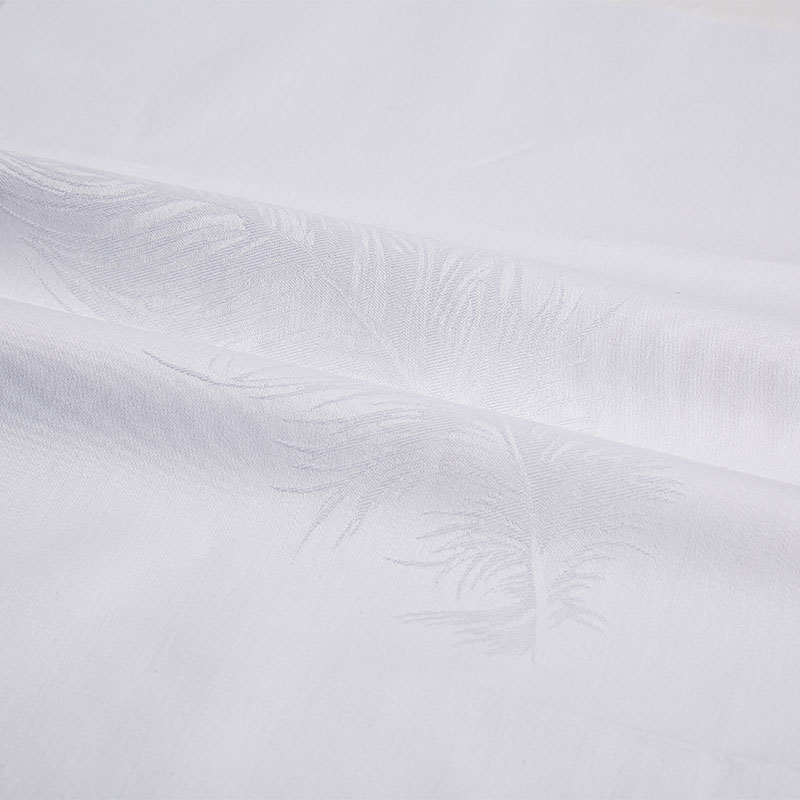
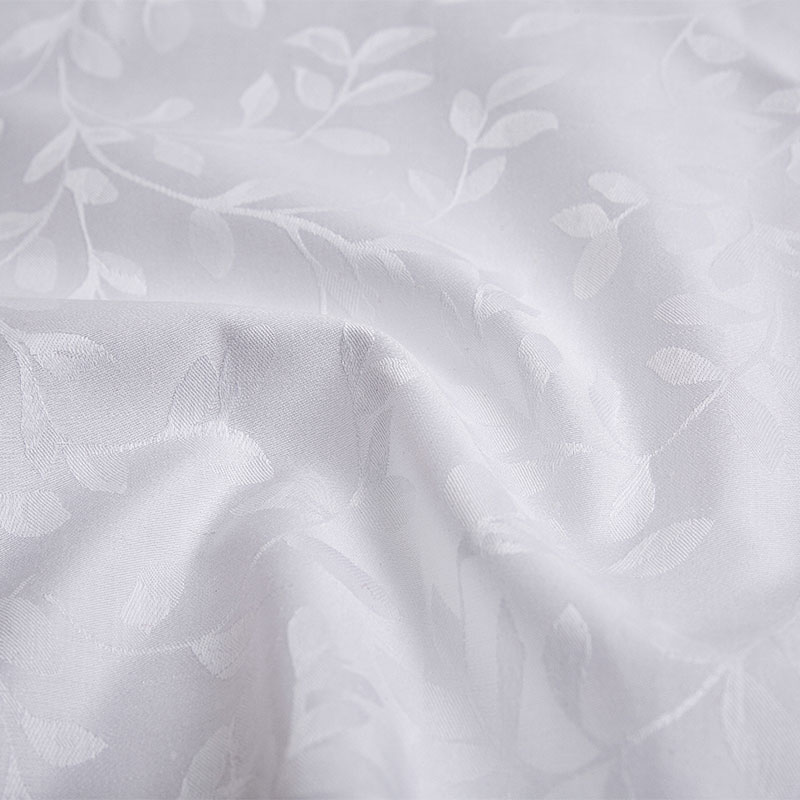
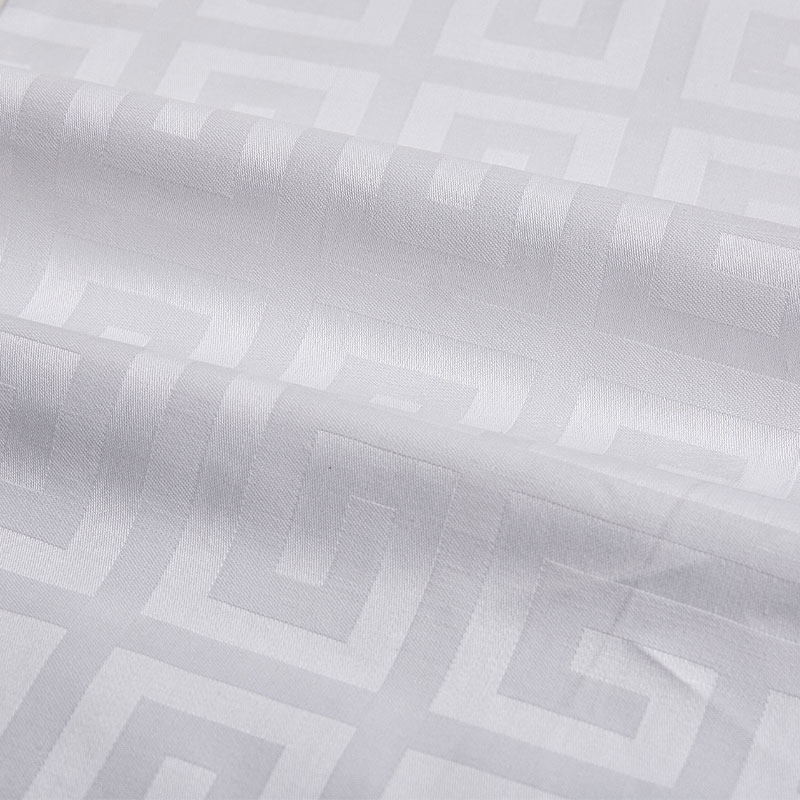
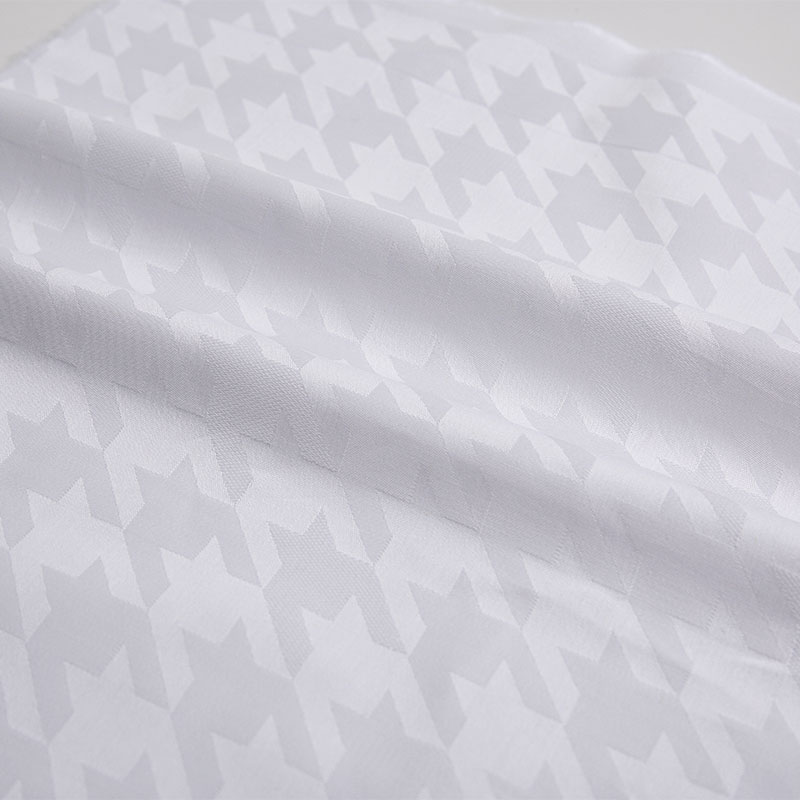
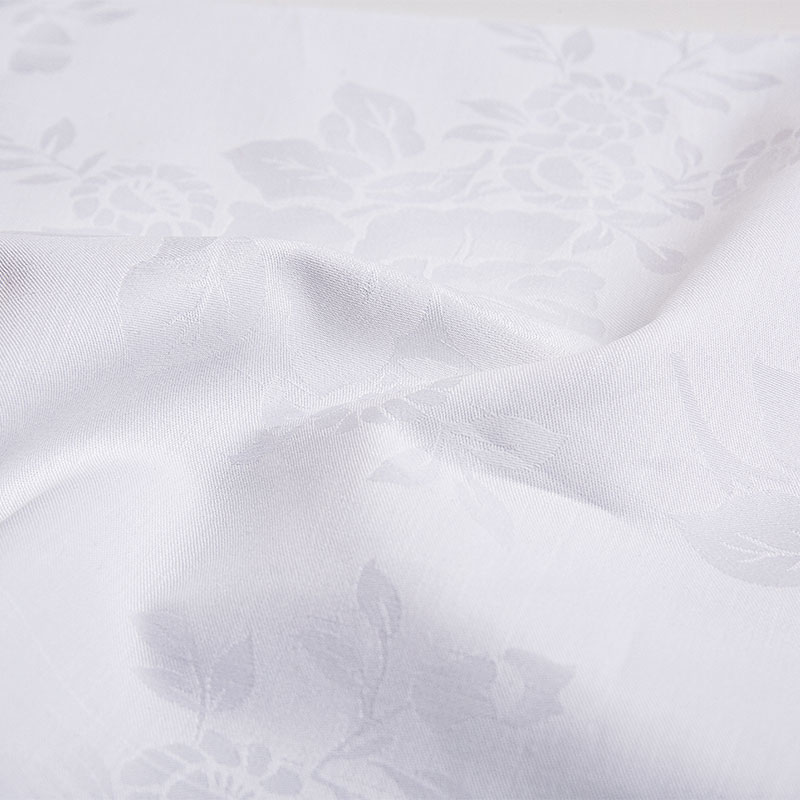
| Damask / Jacquard | Patterned, decorative | Moderate | Moderate | 5-star, palace hotels, duvet covers |
For most commercial hotel operations, percale weave at 250–300 thread count in a cotton-poly blend represents the best balance of guest comfort, laundry performance, and procurement cost. Reserve sateen weave for properties where the tactile premium is a marketed differentiator — sateen shows oil marks and snags more readily under heavy commercial use.
Matching Fabric Specification to Hotel Tier and Guest Profile
No single fabric works across all hotel categories. The right specification depends on your market position, average daily rate, laundry infrastructure, and guest expectations.
| Hotel Segment | Recommended Fabric | Thread Count | Weave |
|---|---|---|---|
| Economy / Budget (1–2 star) | 50/50 Cotton-Poly or Microfiber | 180–220 | Percale |
| Midscale (3 star) | 60/40 Cotton-Poly Blend | 220–280 | Percale |
| Upper Midscale (3.5–4 star) | 60/40 Cotton-Poly or 100% Cotton | 280–350 | Percale or Sateen |
| Upscale (4–4.5 star) | 100% Long-Staple Cotton | 300–400 | Sateen |
| Luxury (5 star) | 100% Extra-Long Staple Cotton | 400–600 (single-ply verified) | Sateen or Jacquard |
Total Cost of Ownership: Calculating True Fabric Value Per Wash Cycle
Purchase price per sheet is a poor indicator of value in hotel procurement. The meaningful metric is cost per usable wash cycle — which accounts for how many times a sheet can be industrially laundered before requiring replacement. A cheaper sheet replaced twice as often delivers the same unit cost with double the procurement burden and inventory complexity.
The chart illustrates a consistent pattern: cotton-poly blend converges to the lowest cost per cycle at scale, making it the most defensible choice for midscale operations. Linen's high purchase price amortizes effectively over 400+ cycles — a genuine long-term value for properties with low-temperature, gentle laundry programs. Bamboo viscose and standard 100% cotton both reach end-of-life before their per-cycle cost becomes competitive, making them poor value choices for high-volume laundry environments.
Laundering Compatibility: Matching Fabric to Your Laundry Operation
The wrong fabric choice creates costly downstream problems in hotel laundry operations. Before finalizing any specification, verify compatibility across four critical variables:
- Wash temperature tolerance: Standard hotel hygiene programs wash at 60–71°C (140–160°F). Cotton and cotton-poly blends tolerate this range without degradation. Bamboo viscose and some microfiber grades begin to degrade above 60°C, shortening usable life by 30–40%.
- Bleach compatibility: Chlorine bleach (sodium hypochlorite) is standard in hotel whitening programs. Only cotton and cotton-poly blends are fully compatible with repeated chlorine bleach exposure. Bamboo, lyocell, and colored linens require oxygen bleach alternatives, which add cost and reduce whitening effectiveness.
- Post-dryer shape retention: Sateen cotton wrinkles severely if left in the dryer between shifts. Cotton-poly blends and microfiber have significantly better shape retention, reducing ironing labor by an estimated 15–25 minutes per 50-sheet load — a meaningful operational cost at scale.
- Outsourced laundry compatibility: If using an external laundry contractor, confirm your chosen fabric falls within their standard processing program. Non-standard fabrics — particularly bamboo or linen — may incur surcharges or require separate processing that eliminates procurement savings.
Climate and Property Type: How Environment Should Influence Your Fabric Choice
Climate is a meaningful selection variable that is frequently overlooked in hotel procurement decisions. The distribution below shows how fabric type preferences shift across different property environments.
Hot, humid climates — tropical resorts, Southeast Asian properties, Middle Eastern beach hotels — benefit most from 100% cotton percale or linen, both of which maximize airflow and moisture absorption. Cold-climate mountain resorts and northern European city hotels can appropriately use sateen cotton or cotton-poly blends that provide slight warmth retention. Microfiber is specifically contraindicated in warm climates due to its heat-trapping properties and should only be specified for temperature-controlled environments with consistently reliable air conditioning.
Frequently Asked Questions About Hotel Bedding Fabric
Q1: What thread count do most 5-star hotels actually use?
Most luxury hotels specify 300–500 thread count in single-ply long-staple or extra-long staple cotton. Very few use thread counts above 600 — at that density, fabric becomes heavier and less breathable without meaningful softness gain. The primary quality differentiator at the luxury level is fiber length and verified single-ply construction, not raw thread count numbers on the label.
Q2: How often should hotel sheets be fully replaced?
Replace sheets based on wash cycles, not calendar time. For midscale properties, replace after 250–300 industrial wash cycles — approximately 12–18 months at 70% occupancy. Key replacement indicators include pilling, visible thinning at fold lines, persistent yellowing that bleaching cannot correct, and fraying at hems. Maintaining a rotation of 3 sets per bed extends individual sheet life and ensures a fresh set is always available.
Q3: Is white the only practical color choice for hotel bedding fabric?
White remains the operational standard because it permits chlorine bleaching, visually communicates cleanliness, and allows all sizes to be washed together. Boutique and design hotels increasingly use warm ivory, stone gray, or soft blue linen as a brand differentiator — but colored sheets require oxygen bleach programs and separate washing, adding approximately 10–15% to laundry operating cost compared to all-white programs.
Q4: What is the best hypoallergenic hotel bedding fabric for sensitive guests?
Tightly woven 100% cotton percale at 250+ thread count is the most broadly hypoallergenic option — the dense weave limits dust mite penetration while natural cotton fiber rarely triggers contact sensitivities. Lyocell (from wood pulp, not bamboo) is an excellent alternative for guests with cotton sensitivity: naturally smooth, moisture-wicking, and produced without harsh chemical residues that sometimes remain in bamboo viscose processing.
Q5: Can hotels use different bedding fabric specifications for different room categories?
Yes — tiered linen programs are common practice in full-service hotels. Standard rooms may use cotton-poly percale at 250 thread count while suites use long-staple cotton sateen at 400 thread count. The operational requirement is clear labeling and separated laundry streams to prevent premium fabric from entering high-temperature bleach cycles designed for standard linen. Many hotels use different colored hemstitching to identify linen tiers without visible impact on the guest-facing appearance.
Q6: How many sets of sheets per bed should a hotel carry in inventory?
The minimum is 3 sets per bed: one in use, one in the laundry cycle, and one in clean storage. High-occupancy properties or those with on-site laundry and longer processing cycles should carry 4–5 sets per bed. Under-inventorying is a common cost-cutting mistake that leads to rushed laundry practices — shortening sheet life and ultimately costing more than the inventory savings.